You’ve Seen the Symbol a Million Times. But What Does It Actually Mean?
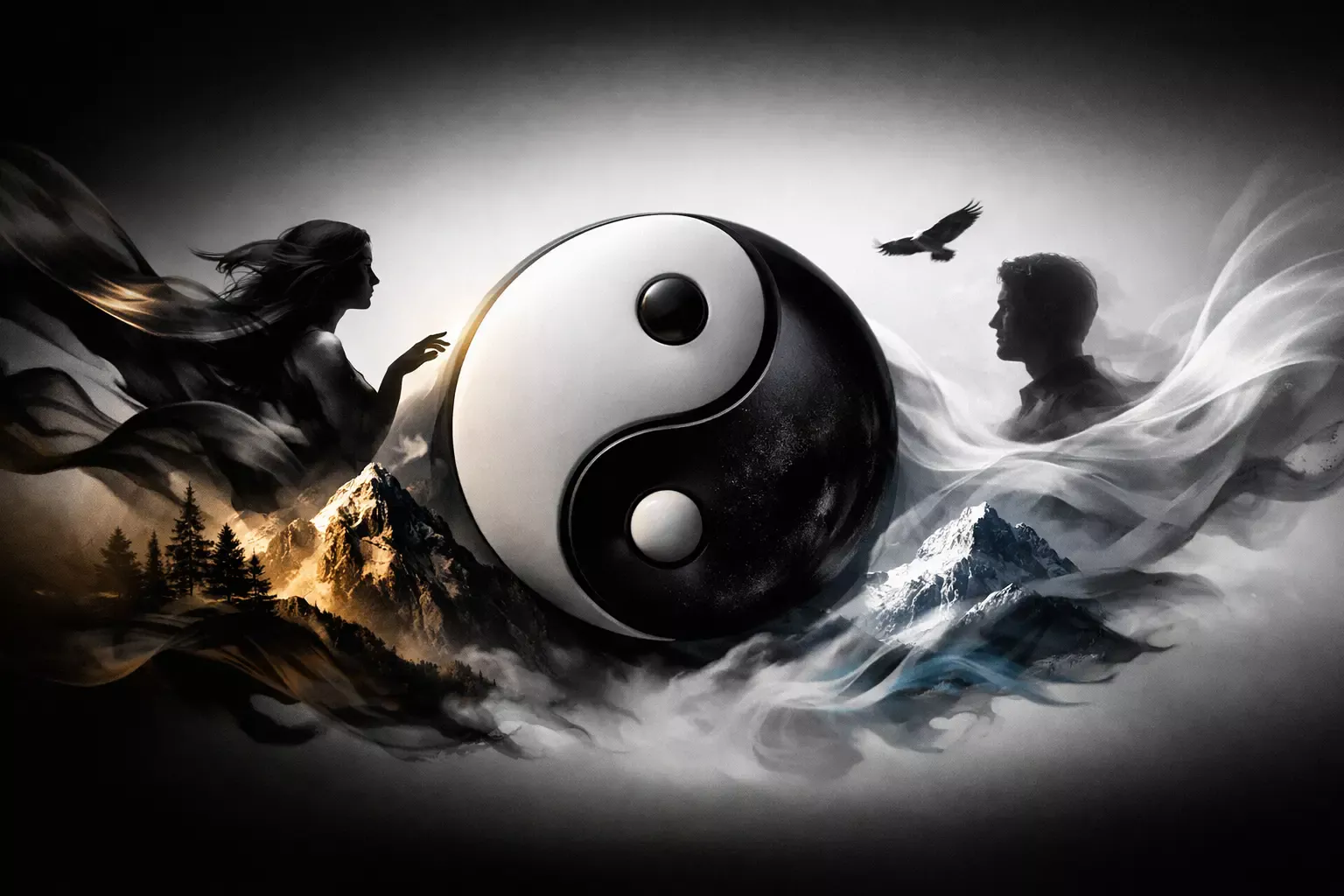
That black-and-white swirly thing on necklaces, tattoo shops, and yoga studio walls? It’s called the Taijitu, and it represents one of humanity’s oldest attempts to explain… well, everything.
Here’s the short version: Yin and Yang are two halves that make a whole. They’re opposites that need each other—like how “up” only makes sense because “down” exists, or how you can’t appreciate Friday without suffering through Monday.
But here’s what most people get wrong: Yin and Yang aren’t good versus evil. They’re not fighting each other. They’re more like dance partners, constantly flowing into one another.
Let’s break this down with examples you’ll actually remember.
The Star Wars Connection (Yes, George Lucas Was Influenced by This)
If you’ve watched Star Wars, you already understand more about Yin-Yang than you think.
George Lucas drew heavily from Eastern philosophy when creating The Force. The concept of the “tao” is near identical to the Force—roughly translated as “way” or “path,” but in Taoism it refers to a spiritual “flow of the universe” that all things are a part of.
Remember that Prime Jedi mosaic in The Last Jedi? The symbol bears a lot of resemblance to the yin and yang “taichi symbol” and represents complementary forces in balance.
But here’s the key difference: In Star Wars, the Dark Side is evil and needs to be destroyed. In actual Yin-Yang philosophy, that’s not how it works. Unlike in Star Wars, where the Light side and Dark side are often simplified to a good-versus-evil binary, yin and yang are more representative of balance. They are two opposing but complementary existences, of which one cannot exist without the other.
Think about it this way:
- Star Wars says: Destroy darkness to achieve balance
- Yin-Yang says: Darkness and light define each other; trying to eliminate one is like trying to have a coin with only one side
This is why exploring balance and harmony through symbolic jewelry resonates so deeply—it’s a physical reminder that wholeness requires both sides.
The Simplest Way to Understand Yin and Yang
Forget the philosophical jargon. Here’s what Yin and Yang actually represent:
| Yang | Yin |
|---|---|
| The sunny side of a hill | The shaded side of a hill |
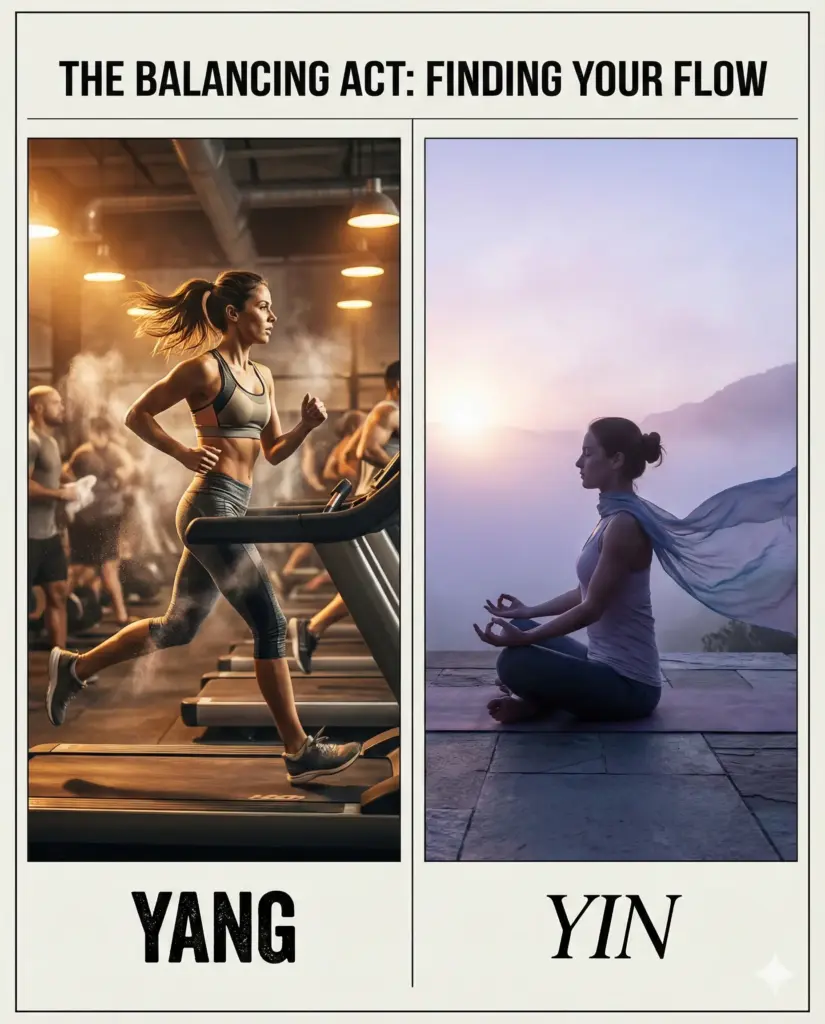
| Action | Rest |
| Speaking | Listening |
| Day | Night |
| Summer | Winter |
| Doing | Being |
| Output | Input |
| Your morning coffee energy | Your 3 PM slump |
| Sending emails | Reading emails |
| Cardio workout | Sleep |
The word Yin comes out to mean “shady side” and Yang “sunny side.” Yin Yang is the concept of duality forming a whole.
That’s literally where the terms came from—ancient Chinese people observing which side of a hill got sunlight and which stayed in shadow.
Why This Matters for Your Actual Life
Your Burnout Is a Yin-Yang Problem
“The art of life is not seen as holding on to yang and banishing yin, but as keeping the two in balance, because there cannot be one without the other,” wrote philosopher Alan Watts. When you’re all-output, all the time, physical maintenance and stress management are non-existent, and that affects performance.
Modern life is obsessed with Yang energy:
- Always be productive
- Hustle harder
- Sleep when you’re dead
- More output, more growth, more results
But cumulative fatigue comes out of your hide the next day and the next, lowering productivity as output overrules the input of recharging.
Real example: You crush a 60-hour work week (maximum Yang). You’re firing on all cylinders. By Sunday, you’re a zombie who can barely form sentences. That’s your body screaming for Yin—rest, quiet, input, recovery.
Or consider why you can’t stop scrolling at 2 AM: Constant connectivity—sending, receiving, and checking messages to the exclusion of a moment to think about any of it—makes it hard to remember the incoming or make any complex decisions based on the information. Pure input without processing. Pure Yin without the Yang of action and integration.
Your Workout Routine Needs Both
Think about fitness:
Yang activities:
- Running
- HIIT
- Weightlifting
- Competitive sports
Yin activities:
- Yoga
- Stretching
- Sleep
- Walking in nature
Balance high-energy workouts with calming practices to prevent burnout and injury.
Athletes who go hard seven days a week eventually break down. Elite performers know that rest days aren’t weakness—they’re when your muscles actually grow. That’s Yin-Yang balance in action.
Your Relationships Run on This Principle
In a romantic relationship, one partner may be more outgoing and energetic (Yang), while the other may be more calm and nurturing (Yin). The balance between these two opposites creates a harmonious and fulfilling relationship.
Think about the best conversations you’ve had:
- One person talks (Yang), one listens (Yin)
- Then they switch
- Back and forth, naturally flowing
Now think about the worst arguments:
- Both people talking (Yang + Yang = collision)
- Or both withdrawing (Yin + Yin = nothing happening)
Balance isn’t about being 50/50 all the time. It’s about knowing when to step forward and when to step back.
Learn more about achieving harmony in relationships through our blog posts on balance.
The Four Rules of Yin-Yang (The Actual Philosophy Part)
Now that you get the basics, here’s the deeper framework that makes this philosophy so powerful:
1. Opposition: Everything Has Two Sides
This one’s intuitive. Day and night. Hot and cold. Work and rest. You can’t understand one without the other.
Example: A wave’s crest is Yang; the trough is Yin. The eggshell is yang while the egg inside is yin. Water flowing calmly is yin but when it goes over the waterfall, it is very yang.
2. Interdependence: One Can’t Exist Without the Other
Neither Yin nor Yang is absolute. Nothing is completely Yin or completely Yang. Each aspect contains the beginning point for the other aspect.
Example: You can’t know what “light” means if you’ve never experienced darkness. Success only feels sweet because you’ve tasted failure. That promotion means something because you remember the rejection emails.
This is why the Yin-Yang symbol has a dot of the opposite color in each half—a reminder that Yang contains the seed of Yin, and Yin contains the seed of Yang.
3. Transformation: Extremes Flip
Sometimes changes in the relationship between Yin and Yang can be dramatic where one aspect can just transform into the other.
Example: Stay up too late (extreme Yang—activity when you should rest) and you crash hard (your body forces Yin on you). Eat only “cooling” foods (extreme Yin) and you’ll crave something spicy (Yang).
Even when it’s high noon, the shadow still exists. Dawn emerges from the darkest part of night. So even in that depth of yin, of darkness, there’s the seed of yang, of light beginning to grow and come through.
4. Balance Is Dynamic, Not Static
The nature of Yin and Yang flows and changes with time. A simple example is thinking about how the day gradually flows into the night. However, the length of day and night are changing.
You don’t achieve balance once and you’re done. It’s a constant adjustment. Some days need more Yang (action, output). Some days need more Yin (rest, input). The skill is recognizing which one you need right now.
What About “Liangyi” (Two Instruments) and “Sixiang” (Four Symbols)?
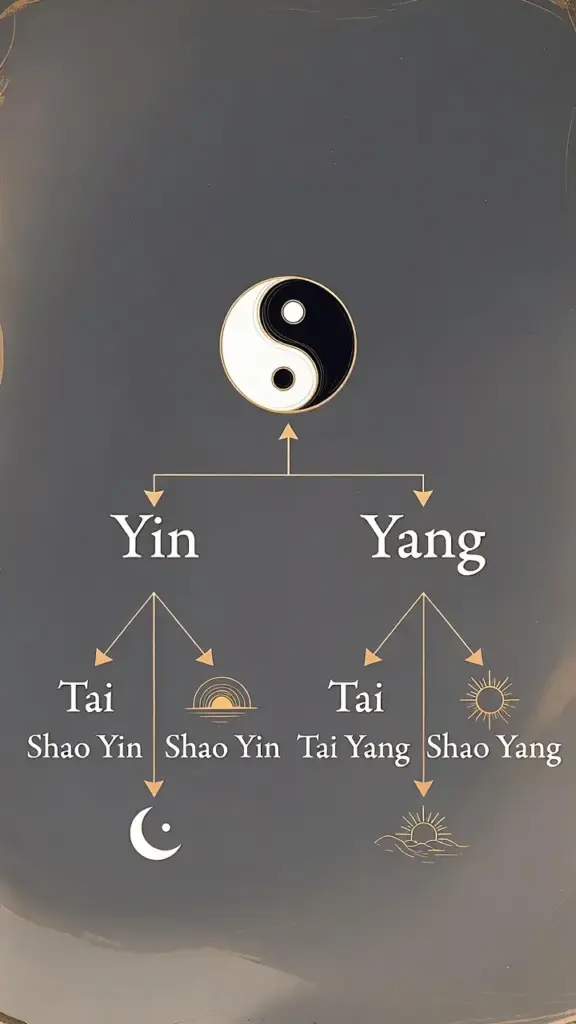
You might have heard these terms if you’ve gone deeper into Chinese philosophy. Here’s what they mean in plain English:
The Two Instruments (Liangyi): Before Division, There Was Oneness
Before Yin and Yang split apart, there was Taiji—the “Supreme Ultimate.” Think of it like the moment before the Big Bang, when everything was one undifferentiated whole.
Then it divided into two: Yin and Yang. That’s the “Two Instruments.”
The famous Yin-Yang symbol (☯) shows this moment frozen in time—two forces that just separated but are still perfectly intertwined.
Why it matters: It’s a reminder that beneath all the apparent opposites in life—good/bad, success/failure, joy/sorrow—there’s an underlying unity.
The Four Symbols (Sixiang): Yin and Yang Divide Further
When you split Yin in half, you get:
- Tai Yin (Greater Yin): Maximum rest, midnight, deep winter
- Shao Yin (Lesser Yin): Rest beginning to include activity, dusk, autumn
When you split Yang in half, you get:
- Tai Yang (Greater Yang): Maximum activity, high noon, peak summer
- Shao Yang (Lesser Yang): Activity beginning to include rest, dawn, spring
Practical example—your energy throughout the day:
| Time | Symbol | What’s Happening |
|---|---|---|
| 6 AM | Shao Yang | Waking up, energy building |
| 12 PM | Tai Yang | Peak productivity, go time |
| 6 PM | Shao Yin | Winding down, transitioning |
| 12 AM | Tai Yin | Deep sleep, full recovery |
This isn’t just philosophy—it’s observation. Ancient Chinese thinkers watched nature and human behavior for centuries and noticed these patterns everywhere.
The Four Celestial Animals
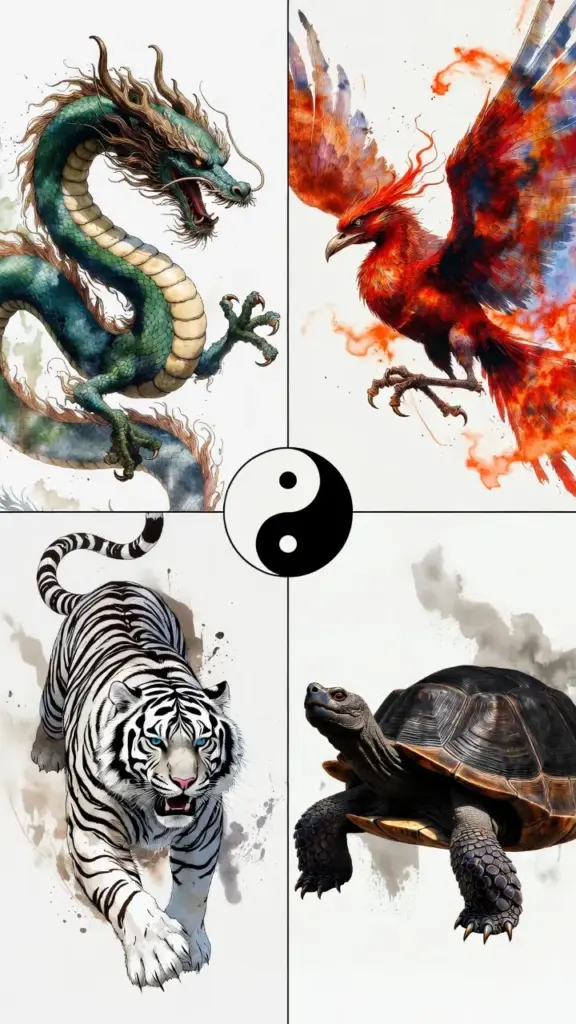
In Chinese astronomy and feng shui, these four phases also connect to mythical guardian creatures:
- Azure Dragon (East): Spring, new beginnings, growth
- Vermilion Bird (South): Summer, peak expression, visibility
- White Tiger (West): Autumn, harvest, letting go
- Black Tortoise (North): Winter, conservation, going inward
These aren’t just decorative symbols. They represent a sophisticated understanding of cycles—in nature, in your life, in everything.
Explore designs inspired by these celestial guardians in our necklace collection.
How to Actually Apply This (Practical Steps)
Step 1: Diagnose Your Imbalance
Have you experienced an inability to relax, anxious, quick to anger or feel frustrated, find you need constant stimulation and can’t sit still? Perhaps a bit too much Yang energy. Or maybe can’t make things happen, heavy moods, feel a bit stuck, no idea what your next step is? Perhaps a bit too much Yin energy.
Too much Yang looks like:
- Burnout
- Insomnia
- Restlessness
- Irritability
- Always “on”
Too much Yin looks like:
- Lethargy
- Procrastination
- Depression
- Feeling stuck
- Never starting anything
Step 2: Treat With Opposites
When we recognise these Yin Yang energies in ourselves it can be as simple as ‘treat with opposites’ to remedy any conditions that might be arising.
If you’re too Yang:
- Schedule actual rest (not just “relaxing” while checking emails)
- Practice breathing that emphasizes the exhale
- Eat cooling foods
- Spend time in nature without an agenda
If you’re too Yin:
- Move your body first thing in the morning
- Make a simple to-do list and check things off
- Connect with other people
- Get sunlight early in the day
Step 3: Build Rhythm Into Your Life
Start your day right by balancing morning energy. If you wake up feeling sluggish, activate your Yang energy by exercising or taking a cold shower. If you feel anxious or overwhelmed in the morning, engage in Yin activities like meditation or gentle stretching.
The goal isn’t perfect 50/50 balance. It’s responsive balance—knowing what you need and giving it to yourself.
The Heavenly Stems: Quick Note on Chinese Time-Keeping
If you want to go even deeper: the Chinese calendar uses a system called the Heavenly Stems and Earthly Branches, which assigns Yin or Yang qualities to different times and cycles.
The ten Heavenly Stems are classified as:
- Yang (odd positions): Jia, Bing, Wu, Geng, Ren
- Yin (even positions): Yi, Ding, Ji, Xin, Gui
This affects everything from Chinese astrology to traditional medicine timing. It’s a rabbit hole worth exploring if this philosophy resonates with you.
Why 3,000-Year-Old Wisdom Still Matters
In a world that celebrates constant doing, perpetual connectivity, and relentless optimization, Yin-Yang philosophy offers something radical: permission to rest.
It tells us that:
- Night is just as important as day
- Listening is just as valuable as speaking
- Recovery is just as productive as work
- Darkness contains wisdom
While the functionality of the yang seems obvious, the value of the yin is often overlooked. A good way to depict this is by taking the example of a vessel. The yang is the physical aspect of the vessel, the hard and dry material, while the emptiness in the vessel is what makes it useful.
Think about that. The emptiness makes the vessel useful. Without it, a cup is just a solid block. A room is just walls.
The spaces, the pauses, the rest—that’s where the value lives.
Wearing Your Philosophy
Many people find that wearing symbolic jewelry helps them remember these principles throughout the day. It’s not magic—it’s a physical anchor, a touchstone that brings you back to balance when life gets chaotic.
That’s the idea behind YinYangRing—rings, bracelets, and necklaces designed as wearable reminders that wholeness includes both sides.
Final Thoughts: It’s Simpler Than It Sounds
Yin and Yang isn’t some esoteric mystery. It’s observation. It’s pattern recognition. It’s what humans noticed when they paid attention to nature, to their bodies, to the way things flow.
The TL;DR:
- Everything has two complementary aspects
- Both are necessary
- They flow into each other
- Balance is dynamic, not static
When something is whole, by definition, it’s unchanging and complete. So when you split something into two halves—yin/yang, it upsets the equilibrium of wholeness. Both halves are chasing after each other as they seek a new balance with each other.
That chase? That’s life. That’s the dance. And understanding it doesn’t make the dance stop—it just helps you move with the rhythm instead of against it.
Want to dive deeper? Check out our blog for more explorations of Eastern philosophy in everyday life, or learn more about our philosophy.
References
- Stanford Encyclopedia of Philosophy – Yinyang (Chinese Philosophy)
- Internet Encyclopedia of Philosophy – Yinyang
- National Center for Complementary and Integrative Health – Tai Chi
- Britannica – Feng Shui
- Britannica – Chinese Astrology
- TED-Ed – The Hidden Meanings of Yin and Yang
- https://claude.ai/public/artifacts/838e59c5-563b-422e-b69c-c77b26bd8404
 English
  French